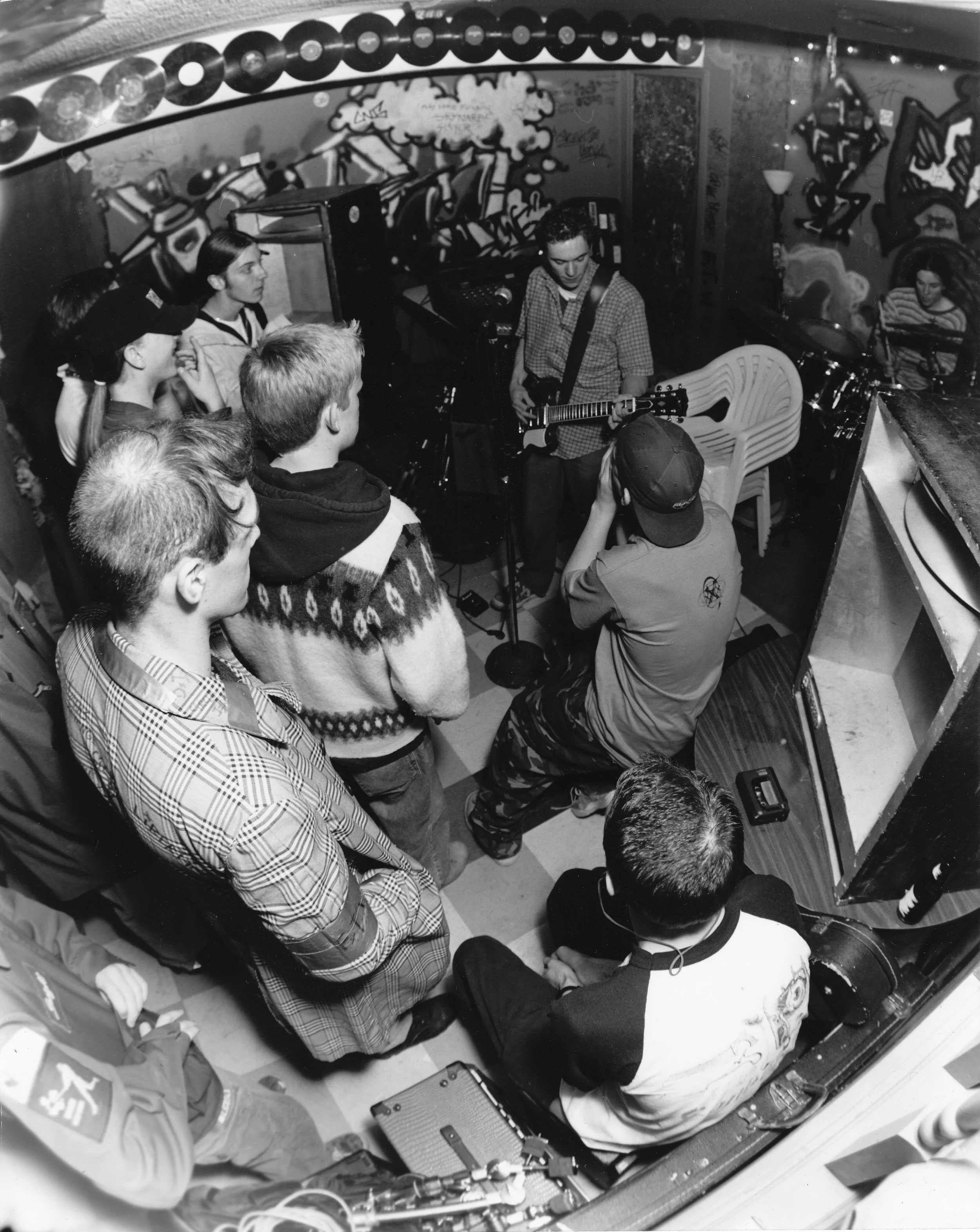
What was the 10 Day Café? A Short Reflection
The 90s in Stratford were a special time. Just before the internet took over our minds, we were drip-fed culture through music, zines, and each other. It was an insulated life, but it didn't feel small. It felt like everything.
I've always loved music but never played an instrument. Most of my friends did, and they had bands, but nowhere to play. So I did what has become my superpower - I organized. Shows, community, people. I brought them together. And boy, was it chaotic.
Some parties went off well. Most didn't. We rented a warehouse under false pretenses and threw shows until the cops caught wind and we were evicted. Another time, I rented a farmer's field, bused teenagers out to a mystery location, and watched the cops shut the whole thing down, stranding hundreds of kids kilometres from town. It was madness. But it was beautiful.
Eventually, tired of getting busted, I decided to go legit. I rented a commercial space downtown - the perfect spot at 41 Market Place. A basement unit beneath a jewelry store, whose owner also happened to be the landlord. The Brennans were unbelievably kind and patient. I still can't believe they rented the space to me. I had to take the apartment above the store too, just to keep future tenants from calling in noise complaints. The location was ideal: Market Square, with City Hall out the front door and the Stratford Police Station out the back. Perfectly positioned, as far as I was concerned, as a fuck you to authority. I called it the 10 Day Café - mainly because I didn't think it would survive more than 10 days.
It ran for two years.
Not without drama. The Building Inspector shut us down in the first week for not having two bathrooms. We built a second one without a permit and reopened. We didn't have a liquor license, so we declared ourselves a private club, and people brought their own booze - many of them underage. The only membership requirement was that you weren't a cop. Somehow, it worked.
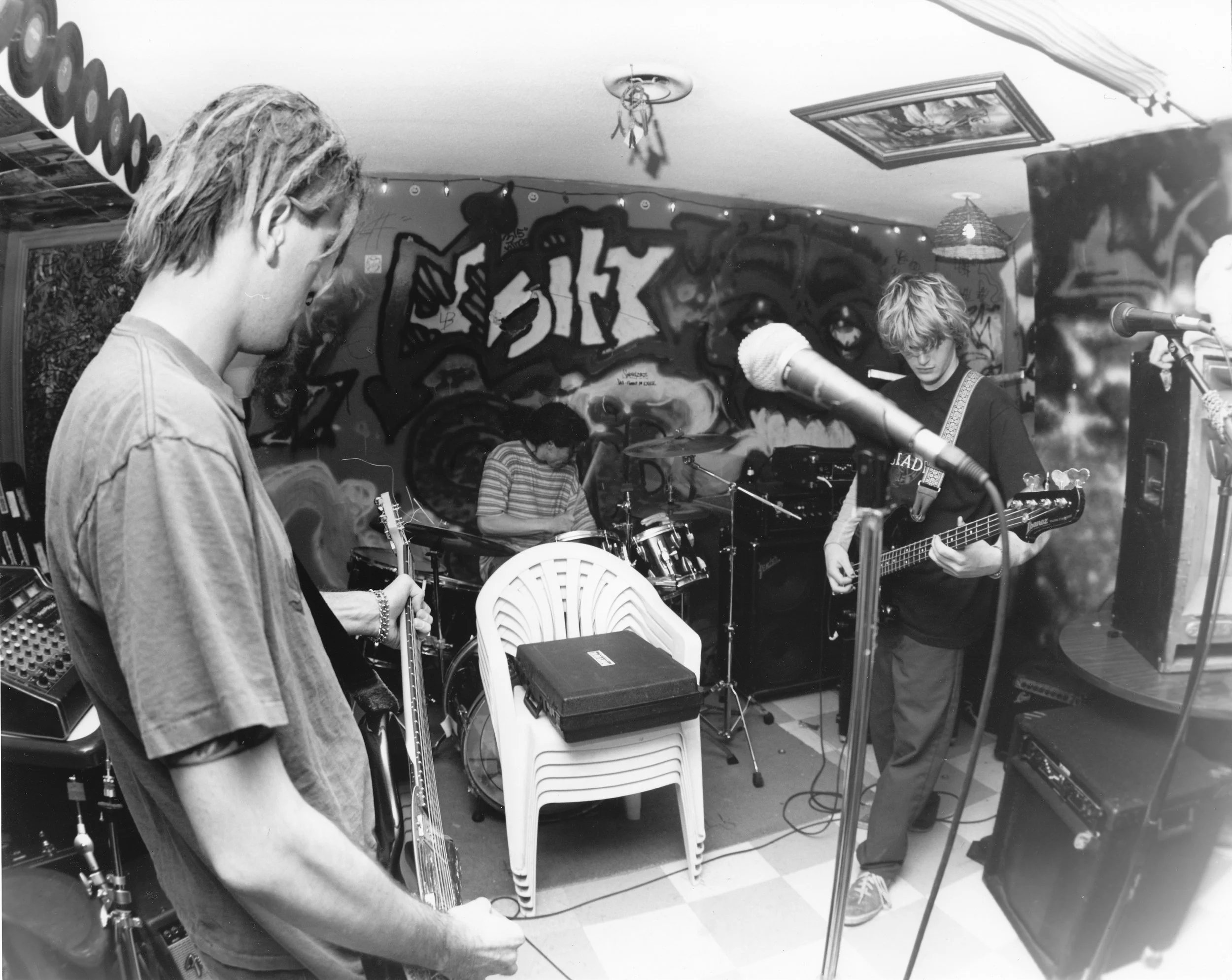
There wasn't much money in it. Five-dollar covers paid for the shows, but not much else. Friends lent a hand - watching the counter, working the door, and volunteering their bands. Nobody was getting rich. But the place was ours, and that was the whole point.
What made it work was the community that walked through that door. And I mean everyone. Skaters, punks, the odd jock, poets, kids in trench coats, tourist teenagers who wandered away from the Stratford Festival and never quite made it back to the bus.
Open from 11 in the morning until really late, on any given night you'd find people playing Euchre in one corner, someone reading Che Guevara in another, a band loading in while two people argued about something that felt, at the time, incredibly important. The 10 Day ran on Jolt Cola, five-dollar covers, and the kind of social electricity that only exists when a bunch of young people decide - collectively, without any real plan - that a place belongs to them.
The music was the base of everything. We had a stable of Stratford bands covering every genre you could imagine - punk and math rock, jazz and hippy jam bands, welfare rock, folk, and death metal. The Fazman, Anger Doesn't Help, Lungbutter, Dayna Manning, Terpic Stick, Rhythm Lee Challenged, Tasty, Curtis, Casual Slacks, Floor Panel, Puckering Rectums, Synthetic Lout, Molotov Children, Pheska-9, Broken Throttle, Starvin Marvin, Miagi - and so many more I can't remember them all. Local kids, local sounds, every one of them with a home at the 10 Day.
But we weren't just a local scene. We had regulars who'd make the drive in from what felt, at the time, like far-off places. Barrie, Windsor, Toronto. Pedestrian Status, Random Killing, Grayline, The Ed Toast Band, Dr. Sauce and the Lads, 4 X Out, Daily Murders, The Sinisters, Method 8, Super 88, Zuul's Evil Disco, Big Daddy A and the Merves. They kept coming back, which told us something. The 10 Day wasn't just a room; it was a destination. Word had gotten out that something real was happening in that Stratford basement, and bands wanted to be part of it.
And sometimes we'd land someone bigger. Probably the biggest was Art Bergmann - still pretty obscure - but recognized as one of the godfathers of Canadian punk through his work with the Young Canadians in the 1980s. He played the 10 Day right after winning a Juno in 1996. For $250 and a ride to and from Toronto, he spent an evening playing acoustic guitar to a room full of kids who were born when he was blazing Canada’s punk rock trail. He opened with a line that set the tone perfectly: "Nobody should have to do punk rock twice." On the drive back to Toronto, we shoplifted Häagen-Dazs together. It doesn't get much more punk rock than that.
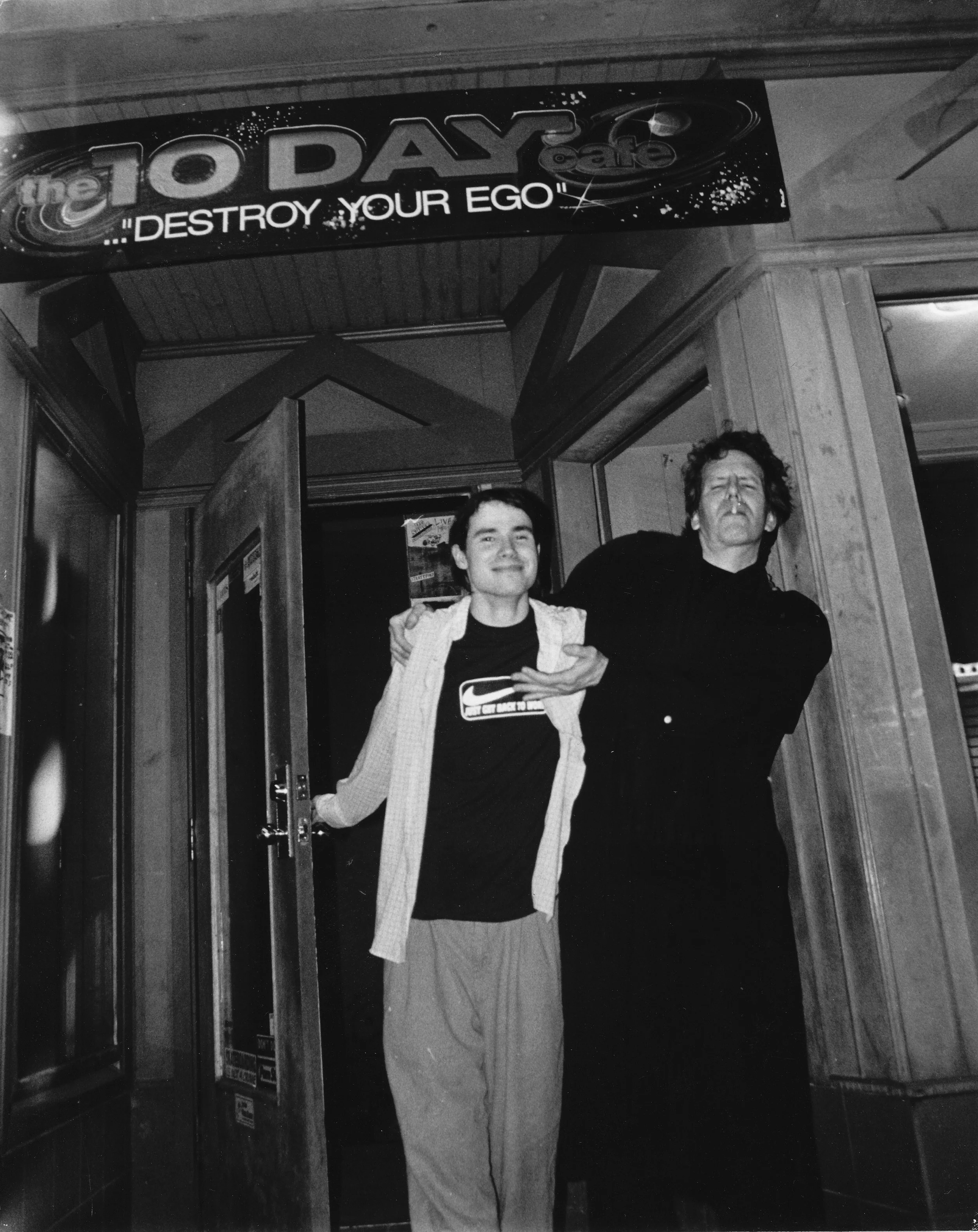
We also had our very own freak show. The Oddity, as we called him, was a staple of 10 Day nights. A friend who lifted objects with his piercings, including a clothes iron suspended from his penis piercing. He'd pierce his cheeks with a bicycle spoke and set his arms on fire. It was always a roof-raiser when he took to the stage and pulled up his kilt for the reveal.
There were so many amazing shows that it is impossible to pick a favourite, but a few stick out as particularly wild. There was the time Elevator To Hell (formerly Eric’s Trip) showed up to play after totalling their tour van on the highway. With their tour van on a flatbed tow truck, they arrived and played a blistering, ear-bending guitar show that surely sowed the seeds of my hearing problems.
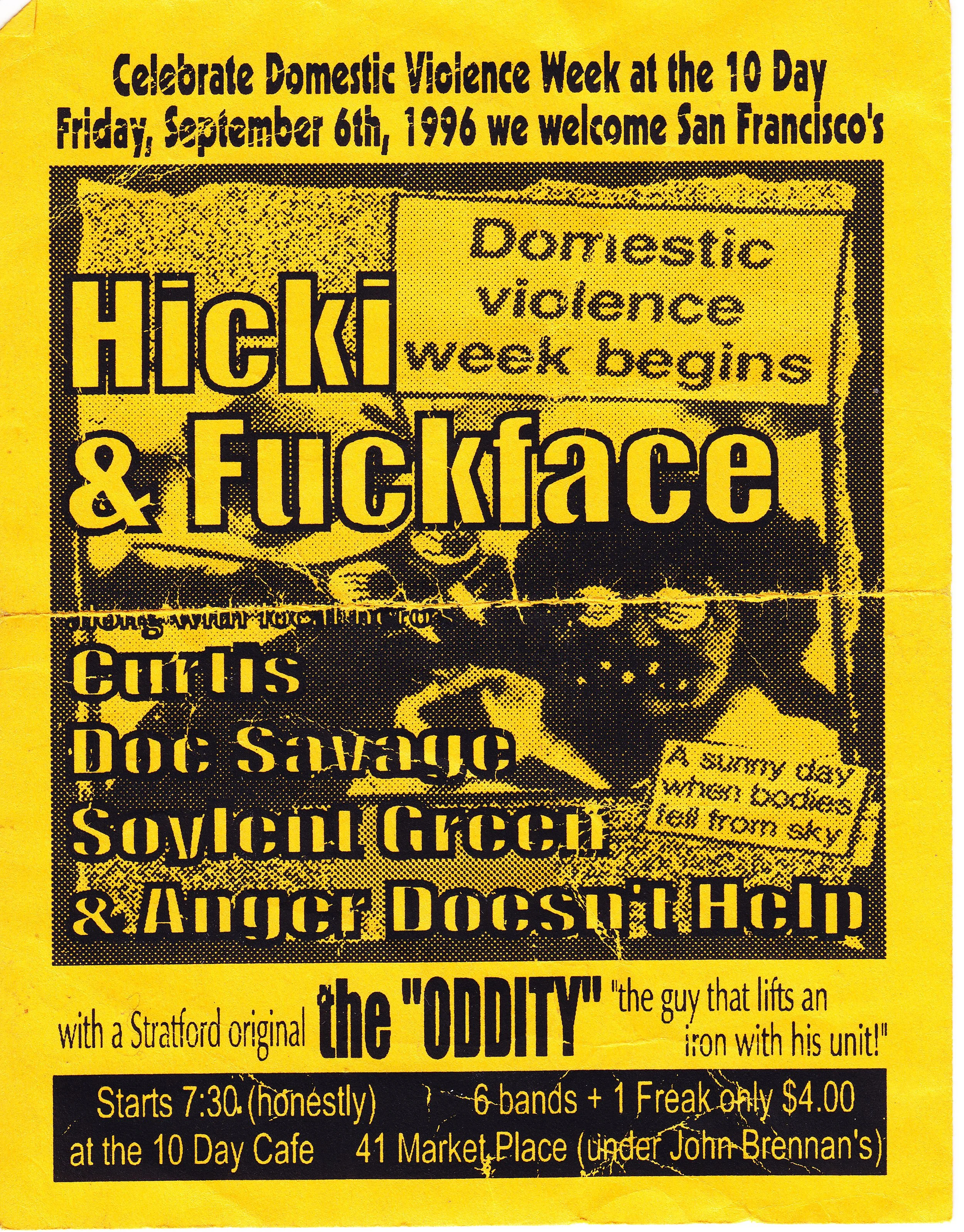
Another weekend, two bands from San Francisco showed up - Hickey and Fuckface - hardcore punk acts who seemed almost exotic to us at the time. They just travelled the continent playing wild music and living out of their van. The 10 Day found itself on the punk rock word-of-mouth circuit because we could always deliver a crowd, throw a band enough cash to get to the next town, and offer a place to crash in the apartment upstairs.
The poster promoting that show used a Dead Kennedys’ image with the caption "Domestic Violence Week Begins." Looking back, it was, to put it mildly, in poor taste. At the time, it seemed hilarious. The local women's shelter didn't see the humour in it, and on the night of the show, there was not only a lively rock show happening in the basement but an active protest of several dozen very unhappy housewives out front, local paper in tow. A hardcore punk show below ground and a picket line at street level. Even by 10 Day standards, it was a scene.
Then there was the night the Stratford Police were intent on raiding the place. Anger Doesn't Help was on stage, and I was working the front door when two cruisers pulled up. The café was packed. Our legal capacity was 60 people, but as was usually the case on weekends, we had easily triple that crammed inside. The stairs going down into the café were jammed with bodies. With the cops standing at the entrance, somebody grabbed the mic and announced what was happening, directing everyone on the stairs to sit down and block the cops from coming in. What followed was a two-hour standoff. The bands kept playing. The cops stewed outside. And I stood at the front door making polite small talk until they eventually gave up and went home.
Our shows were never really contained to the 10 Day. The antics often spilled out into the downtown streets of Stratford. During the summer, when the Stratford Shakespearean Festival was operating, the Avon Theatre would often become the target of what we called pointless pickets.
Thirty or forty teenagers, often dressed in costumes pillaged from the Salvation Army bins down the street, would descend on the theatre entrance armed with handmade placards and an absolute commitment to nonsense. Chants like "We demand social acceptance of those who wet themselves - we are pee-ple too!" delivered with complete sincerity to bewildered theatregoers still emotionally processing two and a half hours of Shakespeare.
The causes were always absurd by design, demanding the return of the mid-afternoon to leisurely activities, calling for the liberation of some fictional political prisoner like our friend Nate Powell, rallying for the rights of the chronically overdressed. The signs were barely legible. The chanting was enthusiastic. The agenda was nonexistent.
Needless to say, walking out of the Merchant of Venice and into that scene was jarring for most. Stratford Festival tourists, largely bused in from Toronto and the American Midwest, were not accustomed to this particular brand of civic engagement. Some laughed. Some were confused. Some were horrified. All of which, of course, was exactly the point. It wasn't a protest about anything in particular - it was proof that we could. That we were here. The city had to make room for us, whether it wanted to or not.
What I understand now, which I didn't fully understand then, is what the 10 Day actually was. It wasn't a café. It wasn't a venue. It was a container for a generation of young people in a mid-sized Ontario city who needed somewhere to figure out who they were. The music was the draw, but the community was the point. That space gave people permission to be weird and to be themselves.
It closed after two years. It was always going to. But what it left behind didn't close with it.
For me personally, the 10 Day was the foundation for everything that came after. It was where I learned to organize - to bring people together around a shared idea and build something out of nothing but a lease, a few friends, and a lot of stubbornness. It also pulled me into local politics and a career in public service. I started showing up at city hall, asking questions, pushing back, eventually running for council - and getting elected.
It was also my first foray into owning a business downtown, and that's the thread that's run through everything since. The 10 Day was a wild, exhausting, exhilarating crash course in commercial real estate, regulations, neighbours, customers, and the strange magic of a street corner that becomes more than the sum of its storefronts. It sparked a passion for downtowns and main streets that has shaped my career ever since. Today, I work on building solutions for small businesses and downtowns across Canada, helping other communities figure out their own version of what we figured out on Market Square in Stratford. The DIY ethic that ran the café still runs through everything I do.
None of it was the plan. The plan was to stay open for 10 days. What we built in that basement instead has shaped the rest of my life.